
St Michael's and All Saints, Dafen, Llanelli
This is an organ by Lidiatt and Sons, that has been modified at various times over the years. Originally a pneumatic system, it was converted to electro-mechanical at some point. This no doubt left them with about half a tonne of lead to sell as a bonus. The electrical system is of the 'nails in blocks of wood' variety, but works perfectly, and added a whole forest of new couplers at the organist's command. Then at some point an extra windchest was added. This was placed (very inconveniently, from the organ tuner's point of view) on top of the walkway. Was there really nowhere else?
However, the most significant detail about this organ is that it uses pneumatic membrane windchests (see pics).
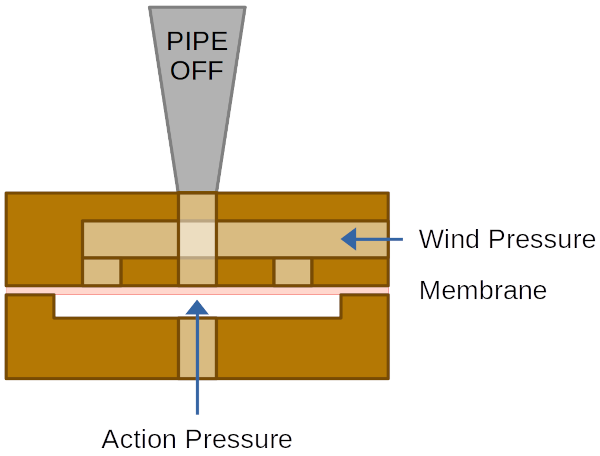
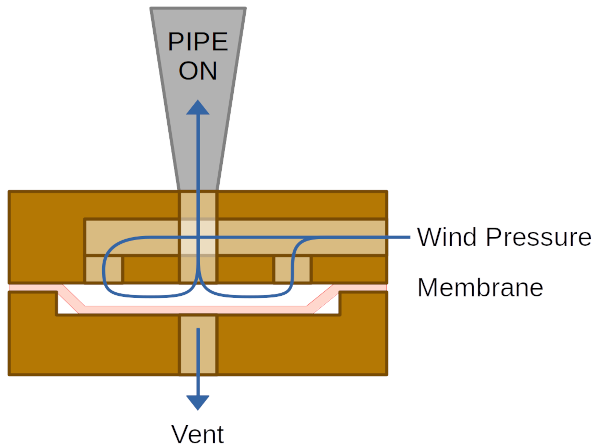
The membrane sits under the opening of each pipe, and is held in place by the Action Pressure (AP) from below. If the corresponding stop is pulled, then Wind Pressure (WP) is introduced to this part of the windchest. This presses against the membrane from above, but is kept sealed shut by the AP from below. This is the closed position. When the corresponding key is pressed, the AP is vented to atmosphere, the membrane moves down, the WP is able to reach the pipe, and the pipe sounds. In this way a large amount of air is controlled by a small amount of air, which is controlled by the key, and the system achieves the required amount of gain.
The problem was that many pipes were refusing to switch off, rendering the organ unplayable. Clearly this would be because the pressures were wrong. The AP needs to be slightly more than the WP in order to push the membrane back up and seal the pipe. However, our measurements indicated the WP was about 1 to 2 cm of water higher than the AP. No wonder it wasn't working. Other evidence that the WP was too high was that some of the pipes were warbling.
We also knew that the organ has two reservoirs, one large, one small, connected together. Some organs use this to counter a phenomenon called concussion, whereby a large reservoir has too much inertia to absorb pressure fluctuations. However, we could see that the larger one is ducted solely to the AP, and the smaller to the WP. It is clearly plumbed for them to operate at different pressures, but they weren't doing so, because there was only one curtain valve. It was a real head-scratcher.
The solution only came when we took the smaller reservoir apart. There, inside it, was a second regulator, completely invisible from the outside, and broken. Once fixed, the regulator permits the pressure of the second reservoir to be set by the number of bricks on top of it, rather than being equal to the first. Suddenly, the whole organ started working just as it should. It was a joy to help rescue this marvellous instrument, and we hope it will play its part in many services to come.