
Capel Carmel, Treherbert
This organ was built by Peter Conacher & Co., probably in 1899. The nameplate is subtitled 'The Old Firm', which is a bit of a personal dig by Peter at his brother James, after he left and started his own competing firm in 1879. The organ underwent wholesale conversion to electro-mechanical in 1989 by Roseway Electronics, using a large number of electromagnets (which for some reason are known as 'zonkers'). These pull down directly on the windchest pallets, which takes quite a bit of current. It would have been more conventional to keep the pull-down motors (i.e. bellows) in place, but converting it back to electro-mechanical is no longer a viable option.
The electronics makes use of 'diode logic' to implement additional features, such as couplers. This takes advantage of the rather generous 16V supply rails that are typically found in electrical pipe organs, and means that the 0.7 V drop of each diode becomes completely insignificant. A typical circuit diagram is as shown below:
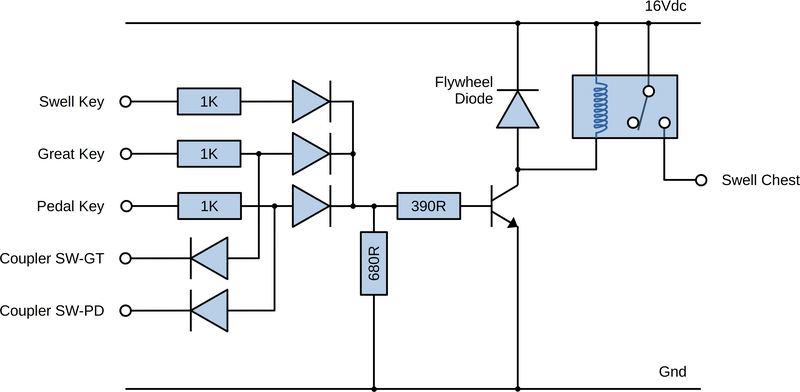
The 'key' signals are high whenever the corresponding Swell key, Great Key, or Pedal Key are pressed. This circuit would therefore be pertinent only to the bottom 30 notes of the Swell manual, since there are 30 pedals. Similarly, the 'coupler' signals are high when the corresponding coupler stop is pulled. Thus, if 'Great Key' and 'Coupler SW-GT' are both high, then the transistor will switch on, the relay will be energised, and 16Vdc will be driven to the signal 'Swell Chest'. This will energise the corresponding zonker, which will pull down the pallet on the windchest, which allows wind to reach whichever pipes have their slider open.
Note that the signal 'Swell Key' does not need to be connected to any couplers, because this circuit is specifically for the Swell windchest. When the relay switches off, the coil generates a back emf, which would drive the collector of the transistor way above 16V, potentially destroying it. For this reason a 'flywheel diode' is fitted, which conducts only if the bottom of the relay coil goes above 16.7V. The coil energy is then dissipated as a small amount of heat in the diode.
With the circuit diagrams suitably reverse-engineered, it was possible to probe the voltages node by node, and thus identify failed components. Over the intervening 35+ years, several transistors and diodes had gone open-circuit. Replacing them requires some patient use of the soldering iron, since desoldering multi-leg components like transistors is always a challenge, and even more so on copper tracks that are heavily oxidised with age.
The zonker pull-down wires were also adjusted to be much tighter on the pallets, which greatly improves the playability. The last thing an organist wants is a noticeable delay between pressing the keys and hearing the corresponding notes. It is worth noting that the electromagnets meet their point of highest resistance (i.e. breaking the partial vacuum or 'pluck' of the pallet) at full extension, which is their point of least pull force. Despite this, I think they perform perfectly well, and the electronics have been done in such a way that the organ will remain feasibly repairable well into the future – and by 'feasible', what I really mean is 'within budget'.